 “When plunder becomes a way of life for a group of men in a society, over the course of time they create for themselves a legal system that authorizes it and a moral code that glorifies it.”
– Frédéric Bastiat, The Physiology of Plunder (1848)
Behind the Curtain
Do you pay your taxes?
Do you like knowing that a massive portion of your hard-earned tax dollars are routinely squandered by politicians? Does this give you a warm and fuzzy?
If you’re a working stiff, like millions of other hardworking Americans, your federal income tax and Social Security deductions are automatically withheld from your paycheck before you ever see a dime. Uncle Sam is always paid first. You simply receive whatever leftovers remain.
In other words, your private property – your money – isn’t really yours until after Washington exacts its pound of flesh.
We’ve all been taught from a young age a very simple, common-sense story about why we tolerate this arrangement. The government needs our money to pay its bills. Without our regular tax dollars, we’re told the lights in Washington would go out, the military wouldn’t get paid, and the nation’s roads would crumble and decay.
But according to one of the highest-ranking central bankers in American history, this story is completely false. In January 1946, just months after the end of World War II, a respected financial journal called American Affairs published an essay that exposed just how the U.S. monetary system actually works behind the curtain.
Most people have never even heard of this important article. You certainly won’t find its insights in a high school civics textbook. Many people can’t handle its implications.
Yet, nearly eight decades later, the monetary mechanics detailed in those pages explain almost everything that’s happening to government finances and your own money today. Specifically, it explains the runaway $40.6 trillion national debt and the relentless erosion of your purchasing power through ongoing dollar debasement.
This is a critical story you must know and understand so you can save and invest in ways that protect your wealth and limit how much you’re being taken advantage of.
Meet the Architect of Your Paycheck Withholding
To understand why the January 1946 issue of American Affairs is so important, you first have to know who wrote the lead piece. His name was Beardsley Ruml.
You’ve likely never heard of him. Ruml wasn’t a flashy politician. He was an insider’s insider.
At the time he penned the article, Ruml was sitting in one of the most powerful financial chairs on the planet. Chairman of the Federal Reserve Bank of New York. Before that, he had been the treasurer of R.H. Macy & Co. and a top advisor to the F.D. Roosevelt administration.
And while you’ve likely never heard of Beardsley Ruml, you experience his handiwork every single time you look at your pay stub. During World War II, Ruml was the mastermind who devised the system of automatic income tax withholding.
Before Ruml, Americans paid their taxes in a lump sum at the end of the year. This made the cost of government painfully obvious to every citizen.
Ruml figured out that if you siphon the money out of people’s paychecks before they ever see it, they won’t complain nearly as much. This allows Washington to collect vastly more money without sparking a tax revolt.
So, when Beardsley Ruml sat down to write about the nature and purpose of federal taxes, he wasn’t pontificating from the sidelines. He was one of the guys pulling the levers.
And what was the title of his January 1946 essay in American Affairs?
“Taxes for Revenue Are Obsolete.”
Read that title again. It doesn’t say, “Taxes Are Too High.” Nor does it say, “We Need Tax Reform.” Rather, it says, Taxes for Revenue Are Obsolete.
The Secret Behind the Curtain
In the introduction to Ruml’s piece, the editor of American Affairs summarized Ruml’s core thesis:
“His thesis is that, given control of a central banking system and an inconvertible currency [a currency not backed by gold], a sovereign national government is finally free of money worries and needs no longer levy taxes for the purpose of providing itself with revenue. All taxation, therefore, should be regarded from the point of view of social and economic consequences.”
In other words, Ruml admitted in 1946 that once a government untethers its money from gold and hands control of the printing press over to a central bank like the Federal Reserve, the government never actually runs out of money. That’s because, at whim, the Fed can conjure up trillions of dollars out of thin air with a few keystrokes.
If Washington needs a billion dollars for a new program, it doesn’t have to wait around for taxpayers to send in checks. The Fed simply buys government bonds with newly created digital currency – currency that’s created out of thin air – and voilà, the Treasury has its cash.
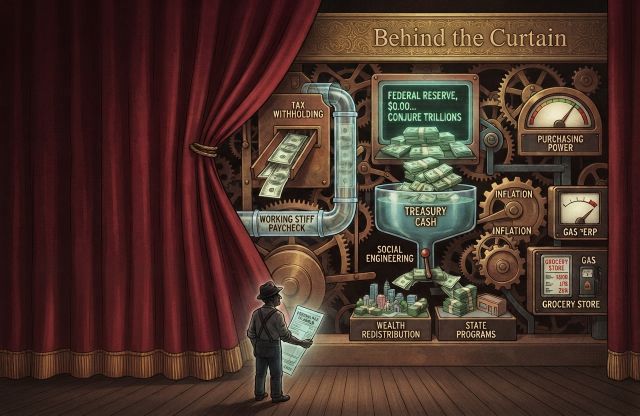
So, if Uncle Sam can create all the money he wants out of nothing, why on earth does he still force you to file a 1040 with the Internal Revenue Service every year?
Ruml laid out the exact two reasons taxes still exist.
First, he argued, taxes are used to mop up excess cash in the economy so prices don’t spiral out of control. His logic was that if the government prints billions of dollars and dumps it into the economy, people will have too much money in their pockets, go on a spending spree, and bid up the prices of goods and services. To stop that, the government taxes the money right back out of your pocket so you can’t spend it.
Of course, like the doctrines of today’s Modern Monetary Theory advocates, this conveniently ignores the fact that when the government turns around and spends that taxed money itself, it bids up prices anyway. Moreover, it ignores that politicians are hesitant to raise taxes because this could result in them losing their jobs.
But it’s Ruml’s second reason for taxation that pulls back the curtain on the entire modern political project.
Social Engineering Disguised as Fiscal Policy
If taxes aren’t actually needed to pay the government’s bills, what is their real job?
According to Ruml, it’s social engineering. Specifically, taking money from one group of citizens and handing it to another to reshape society according to the vision of the planners in Washington.
Here is how Ruml put it, word for word, in that 1946 article:
“The second principle purpose of federal taxes is to attain more equality of wealth and of income than would result from economic forces working alone. The taxes which are effective for this purpose are the progressive individual income tax, the progressive estate tax, and the gift tax. What these taxes should be depends on public policy with respect to the distribution of wealth and of income. These taxes should be defended and attacked in terms of their effect on the character of American life, not as revenue measures.”
In short, Ruml is telling us that the progressive income tax, the estate tax, and the gift tax have nothing to do with balancing the federal budget. They exist for one reason, to override the free market.
In a genuine free market, wealth is distributed based on value creation. Whoever builds the better mousetrap, provides the most helpful service, or works the smartest earns the reward. In 1975, for example, Gary Dahl became an overnight millionaire selling pet rocks. By nature, free economic forces produce unequal outcomes because people have different talents, ambitions, and work ethics.
When the state steps in and uses the tax code to artificially alter those outcomes, penalizing the productive through progressive tax brackets and redistributing that wealth to favored groups or state-run programs, you are looking at the textbook definition of a socialist policy. It doesn’t matter whether it’s dressed up in the language of social justice, fairness, or equity. Anytime a central authority uses legal force to confiscate property from one class of citizens to re-engineer the “character of life” and bring the economy under the control of master planners, it’s collectivizing the fruits of individual labor.
Even more revealing is how the two halves of this system work together. When Senator Nelson Aldrich helped create both the Federal Reserve System and the federal income tax back in 1913, he wasn’t creating two separate agencies. He was building a single, two-stroke engine for total economic control. The Fed creates money out of debt at the top, and the IRS manages the population’s behavior and wealth distribution at the bottom.
The Hidden Tax You Pay Every Day
For the last eighty years, Washington has been running the Beardsley Ruml playbook. And we’re now living through the end game.
Look at the structural fiscal insanity of the United States today. The U.S. national debt has blasted past $40.6 trillion, and the federal government is routinely running $2 trillion annual budget deficits.
Politicians on both sides of the aisle love to go on television and talk with sincerity about fiscal responsibility and cutting wasteful spending. Yet this is pure hogwash.
Under the Ruml design, Congress doesn’t care if tax revenues cover federal spending because taxes were never meant to pay the bills in the first place. When tax receipts fall $2 trillion short every single year, the Treasury simply issues more debt, and the central banking machinery steps in to monetize it.
And because modern fiat money is literally created out of debt, meaning if every debt were paid off tomorrow the entire money supply would vanish, our leaders cannot allow the debt to shrink. The machine requires ever-larger doses of debt and newly conjured currency just to keep from seizing up.
But here’s the catch that Ruml conveniently disregarded in 1946. You can print endless amounts of fiat currency, and you can rack up $40 trillion in debt, but you cannot print real wealth. You can’t print extra bushels of wheat, more barrels of oil, or additional houses.
When the Federal Reserve, working hand in glove with the Treasury, floods the financial system with trillions of unbacked dollars to cover $2 trillion annual deficits, the inevitable consequence is that every individual dollar loses value. While economists refer to this phenomenon as inflation, everyday Americans experience it as relentlessly rising prices.
Over just the past few years, this erosion of purchasing power has dramatically adjusted the daily cost of living. It is visible at the grocery store, where a cart of basic staples like eggs, beef, milk, and bread that once cost $100 now easily rings up at $175. It follows drivers to the dealership and the gas pump, where vehicle prices, repair bills, fuel costs, and insurance rates have surged far beyond what normal supply-and-demand shifts could explain.
Perhaps most painfully, it has reshaped the housing market. Starter homes are now priced well out of reach for a generation of young Americans. This is not because lumber and land suddenly grew scarce. But rather, because trillions of newly created dollars began chasing a finite supply of real estate, compounded by local planning and zoning codes that inhibit new development.
This is the grand illusion of fiat money in action. Policymakers in Washington no longer need to pass unpopular laws raising income tax rates to 70 percent to extract wealth from the public. Instead, they can run massive deficits, debase the currency, and allow inflation – the ultimate hidden tax – to quietly siphon value out of your bank account while you sleep.
History shows that every nation that abandons sound money for an unlimited, debt-based fiat currency eventually collides with the exact same brick wall. A government can rig the tax code for social planning and pretend that deficits do not matter for a remarkably long time, but the bill always comes due.
Ultimately, the currency returns to its intrinsic value – toilet paper and birdcage liner. This, like death and taxes, is a 100 percent guarantee.
[Editor’s note: Get a free copy of an important special report called, “Beyond Crude – An Asymmetric Trade Hidden in a Disrupted Market,” when you join the Economic Prism mailing list today. If you want a special trial deal to check out MN Gordon’s Wealth Prism Letter, you can grab that here.]
Sincerely,
MN Gordon
for Economic Prism
Return from Silent Theft and Social Engineering from Behind the Curtain to Economic Prism