 There is a certain breed of politicians operating in American government today that can’t seem to keep their grubby hands out of the fruits of private wealth. They’re unwilling to recognize that new wealth generated by private enterprise benefits everyone. Blind to the bloody lessons of history, and entrenched in politics of envy, they endeavor to confiscate and redistribute that which does not belong to them.
There’s a battle raging in the USA for the future of artificial intelligence. The outcome will result in two wildly different futures. One future is an America characterized by unrestrained wealth and innovation that propels civilization to new heights. The other is an America characterized by apathy, poverty, and a lumbering and all controlling centralized state.
But while Washington sharpens its tax shears, a completely different story is unfolding down south. Argentine President Javier Milei is doing something remarkable.
Instead of threatening technology builders with the barrel of a regulatory gun, Milei is rolling out the red carpet in Buenos Aires. He’s aiming to turn the city into a free-market sanctuary for AI developers with the most attractive legal and business environment on the planet.
In today’s guest article, our old friend Joel Bowman, in his Note From the End of the World, explores what’s at stake. And what the implication are for free enterprise, personal liberty, and private property rights – both north and south of the equator.
We have no financial arrangement with Mr. Bowman and do not profit from publishing his work. We’re simply sharing this fascinating read with you because we find it valuable and believe you will too.
Enjoy!
MN Gordon
P.S. If you’d like to discover more of Mr. Bowman’s work, head over to his website and subscribe to his newsletter. This will ensure you receive all his latest insights on freedom, liberty, and the culture of the west.
—
The Amsterdam of AI
Buenos Aires welcomes builders, Bernie Sanders wants a stake…

“The system of private property is the most important guarantee of freedom, not only for those who own property, but scarcely less for those who do not.”
~ Friedrich Hayek, from The Road to Serfdom (1944)
Joel Bowman with today’s Note From the End of the World: Buenos Aires, Argentina…
Last week we dared speak a harsh word against communism, a political theory so naturally appealing it must be forced upon people… under threat of mortal violence.
“Political power,” as Mao Zedong famously, unambiguously observed, “grows out of the barrel of a gun.”
Mao’s own namesake version of Trickle Up Poverty was terrifically successful in the Middle Kingdom, with something in the order of 70 million human beings perishing during his iron-fisted reign.
In Mao: The Unknown Story (2005), Jung Chang and Jon Halliday argue that some 38 million men, women and children died during the famine of the Great Leap Forward alone… or about ten million every year between 1958–1962.
An aggressive progressive if ever there was one, Mao was naturally concerned first and foremost with equality of outcomes… so long as that outcome was impoverishment, misery and universal, state sponsored terror.
But why bring any of this up? What does the end of those poor souls’ world have to do with these Notes From the End of Our World?
Ah, dear reader… you know already that there is nothing new under the sun.
Whether in the Middle Kingdom or the Middle East… Americas North or South… civilizations east and west… the story is as old as Father Time himself.
One group makes… the other takes. One prefers cooperation… another resorts to raw coercion. One man tries reason, persuasion, and calm, rational discussion… the next shows him the barrel of a gun.
And so, deaf and blind to the lessons of history, man plods along… repeating the same old follies and conceits that set his ancestors one against the other.
Colonel Confiscator
Which brings us to Bernard Sanders, a man who has made a political career out of a preternatural gift for promising to share with others what doesn’t belong to him in the first place.
Earlier this month, the Senator from Vermont announced he will soon introduce a bill to “give” the public a 50% ownership stake in the largest AI companies in America. Ordinarily known as “fencing stolen goods,” this would be achieved through a one time tax/seizure not on profit… but on stock in the companies themselves. Expropriation, by any other name…
Waffled Sanders:
“This would guarantee that the trillions created by AI are used to improve the lives of all of us — and block oligarch decisions that harm the American people.”
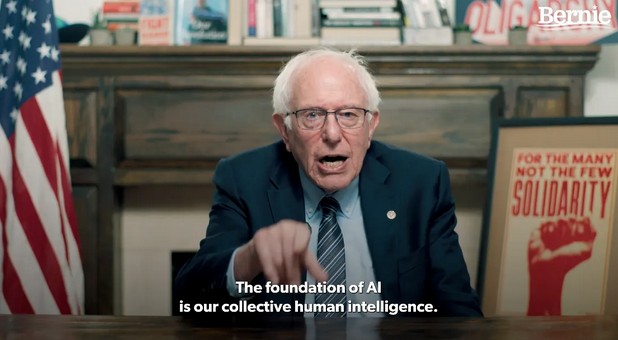
Bernie’s comrades-in-arms will recognize this as good ol’ nationalization of private property for the “common good,” much like the Chairman above presupposed collective ownership of everything from the dirt under his peasants’ feet to the boundless cerulean above. (All to be managed, administered, overseen and apportioned by him and his cronies, of course.)
Bernie’s key claim here is that, because AI was built on the nebulous concept of “our collective human intelligence” – a pool of knowledge to which the senator himself has contributed little, if any, original content – every (American) human is therefore entitled to his or her “fair share” of the profit.
What constitutes a “fair share?” you ask. When does “collective intelligence” suddenly morph into “public ownership”? What kind of precedent would such an act set? And what about that other life form here on planet earth, the “non-American human”?
Or, to boil it down to a single question: what manner of mid-wit intelligence is this, artificial or otherwise?
Alas, the politics of envy is as old as the origins of property itself…
On the Origins of Property
It was John Locke who first articulated the idea that mixing labor and capital with preexisting resources gives rise to property rights. Here’s the famous quote, from Chapter V of his Treatise of Two Governments (Of Property):
“Though the earth, and all inferior creatures, be common to all men, yet every man has a property in his own person. This nobody has any right to but himself. The labour of his body and the work of his hands, we may say, are properly his. Whatsoever then he removes out of the state that nature hath provided and left it in, he hath mixed his labour with it, and joined to it something that is his own, and thereby makes it his property.”
The mere fact that ideas, languages, mathematics, music, science, art, etc. already exist “in the ether” is hardly sufficient to suppose a public ownership claim on any given enterprise that subsequently seeks to turn such an amorphous blob into a commercially viable product through application of its labor and capital.
Following on from Bernie’s “logic,” should Google find itself liable for mandatory state expropriation for having ordered and archived the billions of discrete pages and sites scattered across cyberspace?
How about the Yellow Pages? Encyclopedia Britannica? The Oxford English Dictionary? These humble Notes?
Are these enterprises forbidden from accessing public data and ordering it – through mixing its own labor and capital – such that “We, The Consumers,” might find in this vehicle a new value, one that had not existed when the information was strewn disparately across the vast and extra-jurisdictional realm of our “collective human intelligence”?
In other words, can preexisting information not be rearranged, reimagined, reengineered… archived, ordered, catalogued, etc. … without incurring the wrath of the courts which, armed with Bernie’s Act, might claim ownership over the newly formed property?
Whether the resource is uncultivated land or publicly available knowledge (code, data, etc.), the act of productive transformation affirms rather than diminishes the principle of private property… without which everything and nothing belongs to everyone and nobody.
And yet, it is exactly this kind of nonsensical collectivist gibberish that befuddles college students and animates senatorial calls to arms alike.
Doubtless the promise of an unearned AI windfall will appeal to Bernie’s perma-jilted followers, especially as it would come out of the hides of “evil billionaires,” but it is unlikely to spur innovation of the kind that flourishes in markets that respect foundational liberties, like property rights.
But while the covetous cast their gaze over their neighbors’ fences, others extend invitations instead of threatening confiscations.
The Amsterdam of AI
In a recent op-ed in the Financial Times, Argentine President Javier Milei invited AI entrepreneurs and developers to pursue their innovation on these fair shores, where a favorable legal framework awaits. From the FT:
Companies run by new technologies such as AI agents require the same legal framework that has underpinned capitalism for over four centuries, one suitable for development and experimentation.
At the beginning of the industrial revolution, Adam Smith illustrated the potential of technology and economies of scale in his celebrated recollection of the pin factory. And, as much as the industrial revolution freed us from the constraints of the human muscle, AI will free us from the constraints of the human brain, pushing productivity beyond our wildest dreams.
[…]
We are open for business. In the spirit of the Dutch merchants who made Amsterdam the financial capital of the 17th century, we intend to offer the most attractive legal and fiscal environment for the AI companies that will define the 21st. Let Buenos Aires become for AI what Amsterdam was for the age of sail — the place where the legal imagination caught up with the technological moment, and the world was changed.
Not for the first time in history, the path once more diverges. In which direction is one to proceed?
Toward wealth creation… or wealth redistribution? Private property… or government expropriation? Market innovation… or State control?
Freedom… or the barrel of a gun?
Stay tuned for more Notes From the End of the World…
Cheers,
Joel Bowman
founder of Notes from the End of the World
P.S. Check out Mr. Bowman’s follow-up article titled Artificial Reparations, and discover Sanders’ unlikely bedfellow in the effort to confiscate the fruits of AI for government redistribution. It’s a story that you need to hear. While there be sure to subscribe to his newsletter so you can follow these reflections in real time.