 “We must ever mandate the principle that the people of this continent alone have the right to decide their own destiny.”
– James K. Polk
Ego and Overreach
All world leaders come with big egos. It’s a prerequisite for the job. These outsized egos compel presidents, prime ministers, supreme leaders, and other alphas to overestimate their abilities.
History is littered with leaders who believed they could bend the world to their will without any blowback. They draw lines on a map, launch a surgical strike, or artificially suppress interest rates, convinced that their strength or brilliance will dictate the outcome.
Yet time and again, the universe proves that every action triggers a chain reaction of unintended consequences. The initial triumph masks a hidden trap. What’s more, the true cost of a decision is rarely understood by the people who make it until it is far too late.
Look no further than the events of early 2026. When American forces captured and extracted Venezuelan President Nicolás Maduro on January 3, the operation was hailed by the White House as a masterpiece of tactical boldness. It was swift, clean, and seemingly decisive.
But instead of instilling caution, it taught the Trump administration the wrong lesson entirely. It created an illusion of invincibility. And it convinced President Trump that he could push the envelope even further without encountering real resistance.
That hubris led directly to Operation Epic Fury on February 28. That’s when the United States and Israel launched a massive aerial bombing campaign against Iran. The strikes succeeded in assassinating Supreme Leader Ali Khamenei. But the tactical victory quickly dissolved into a strategic nightmare.
Teheran responded by effectively shutting down the Strait of Hormuz. This choked off a critical shipping corridor for Middle East oil and gas destined for global markets. Energy prices spiked, global supply chains buckled, and the expected quick win devolved into a drawn-out, painful stalemate.
By the time voters went to the polls in the recent midterm elections, the economic pain and geopolitical drag of the Iranian entanglement delivered a severe blow to Congressional Republicans. The red party lost key seats across both the House and the Senate. What began as a boastful victory in Caracas ended as a political disaster at home.
Hidden Price of Manifest Destiny
This pattern of reckless ambition leading to unforeseen catastrophe is deeply woven into the American fabric. Consider President James K. Polk. He was the driving force behind America’s obsession with Manifest Destiny in the 1840s.
Polk was a man of cold calculation who viewed the continent as something to be claimed. He didn’t bother to consider the fallout. When he provoked the Mexican-American War and annexed the western third of the North American continent, he believed he was securing the nation’s permanent greatness.
What Polk failed to grasp was that acquiring 522 million acres of new territory would instantly shatter the fragile political balance between the northern free states and the southern slave states. By opening up the West, Polk unwittingly set the clock ticking on national disunion.
The very generals who marched into Mexico City under his command to expand the republic would, just a little over a decade later, find themselves facing off on the bloodiest battlefields of the American Civil War. Polk got his land. But the nation paid for it in oceans of blood.
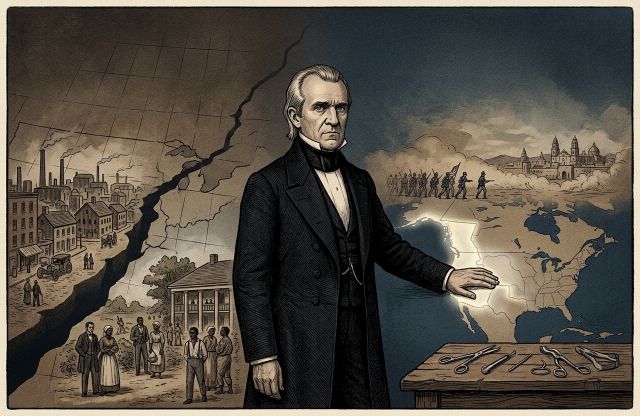
Polk’s unyielding nature may well have been forged in the crucible of a horrifying youthful trauma. As a seventeen-year-old growing up in Columbia, Tennessee, Polk suffered from severe urinary stones. He lived in constant agony. To save his life, he was taken by horse-drawn carriage to Kentucky to undergo a brutal, primitive operation at the hands of Dr. Ephraim McDowell.
As recounted by Hampton Sides in the book Blood and Thunder, with nothing more than a few sips of brandy for an anesthetic, the young Polk was strapped naked to an operating table with his legs hoisted into the air. Dr. McDowell used a medieval instrument called a “gorget” to bore straight through Polk’s prostate and into his bladder to extract the stones. The procedure was a success in terms of survival. But it left Polk sterile, impotent, and permanently scarred.
Biographer John Seigenthaler remarked that Polk “became a man on Dr. McDowell’s operating table. Here, for the first time, were evidences of the courage, grit, and unyielding iron will that Whigs, the British Crown, and the Mexican Army would encounter once he became president.”
Polk pledged to serve only one term, compressed a century of territorial expansion into four relentless years, and worked himself to total exhaustion. He left office gravely ill with a severe intestinal ailment – something he called a “derangement of the bowels” – and died just three months later. He left behind a vastly expanded country poised on the brink of self-destruction.
Perhaps if Polk hadn’t had his most private parts mutilated in the prime of his youth, he would have been content tilling soil and raising kids on the family farm.
The Broken Promise of 1971
Fast forward a century, and another fateful decision reshaped the modern world with equally devastating blindness to the future. In August 1971, President Richard Nixon made the sudden announcement that the United States would close the gold window. This unilaterally severed the last remaining link between the U.S. dollar and gold backing.
At the time, it was framed as a temporary tactical measure to protect the currency from foreign speculators and control short-term domestic inflation. That was a lie.
In reality, Nixon’s decision fundamentally altered global economics forever. By severing the dollar from a physical anchor, he unleashed an era of unchecked fiat currency creation. Without the discipline of gold, American economic priorities shifted away from industry and manufacturing toward financial engineering.
Over the following decades, this transition triggered the systematic deindustrialization of the American heartland, shuttered factories, and hollowed out the working and middle classes.
Floating the greenback turned the U.S. dollar into the world’s primary reserve asset. This sparked structural, chronic trade imbalances.
Because foreign nations needed dollars for global commerce, they steadily bought U.S. financial assets while flooding American markets with cheap foreign goods. This structural trade deficit meant America effectively exported its currency while importing plastic trinkets. Moreover, it gutted domestic supply chains and resulted in persistent trade deficits decade after decade.
Simultaneously, removing the gold constraint destroyed any remaining pretense of fiscal discipline in Washington. It enabled an unprecedented boom in public and private debt, allowing successive administrations to spend trillions of dollars without ever accounting for tomorrow.
Today, the nation finds itself buried beneath a staggering $40.6 trillion avalanche of unsustainable national debt. Alas, this economic abyss was carved out the moment Nixon closed that gold window over fifty years ago.
Gold, Trust, and the Search for a Way Back
The long economic experiment born in 1971 is rapidly approaching its inevitable and disastrous conclusion. Policymakers are finally being forced to search for a way to restore sanity to the monetary system.
Enter Judy Shelton, who recently joined the Treasury Department as a senior advisor to Secretary Scott Bessent. Shelton, a long-time advocate of sound money who was nominated by Trump to the Federal Reserve Board of Governors back in 2020, has spent years arguing that money must be treated as a moral contract between a government and its citizens.
In her book Good as Gold, Shelton outlined a pragmatic proposal to reintroduce metallic backing to American debt. She believes this can be done without creating a massive panic.
Her central idea revolves around creating long-term Treasury Trust Bonds, modeled after Inflation-Protected Securities. Under her framework, investors who hold these bonds until maturity could choose to redeem them either at face value in cash or for a pre-specified amount of gold.
Instead of selling off the nation’s official gold reserves – which stand at roughly 261 million ounces, historically carried on the books at a ridiculous statutory rate of $42 an ounce – Shelton proposes leveraging that gold asset as active collateral. At current market prices, that stockpile represents hundreds of billions of dollars in real physical wealth.
According to Shelton, by pledging gold as collateral for government borrowing, the Treasury could immediately lower borrowing costs, restore confidence in American credit, and begin anchoring the dollar back to tangible reality.
Whether Shelton’s plan can reverse decades of fiscal recklessness remains to be seen. But her arrival highlights a truth that every generation eventually learns the hard way. From Polk’s expansionist fever to Nixon’s currency break, and down to the recent military miscalculations in the Middle East, leaders always assume they can manage the aftermath of their boldest moves.
History, however, keeps an accurate ledger. When governments act without respecting long-term consequences, the debt always comes due.
[Editor’s note: Get a free copy of an important special report called, “Beyond Crude – An Asymmetric Trade Hidden in a Disrupted Market,” when you join the Economic Prism mailing list today. If you want a special trial deal to check out MN Gordon’s Wealth Prism Letter, you can grab that here.]
Sincerely,
MN Gordon
for Economic Prism
Return from Can Returning to Gold Solve Decades of Reckless Federal Spending? to Economic Prism