 “Smart people focus on the right things.”
– Jensen Huang, Nvidia CEO (retread)
Moonshot Bust
The shoe business can be a tough game. The objective is to make good shoes, earn a profit, and enjoy life. Setting money on fire is not the intent.
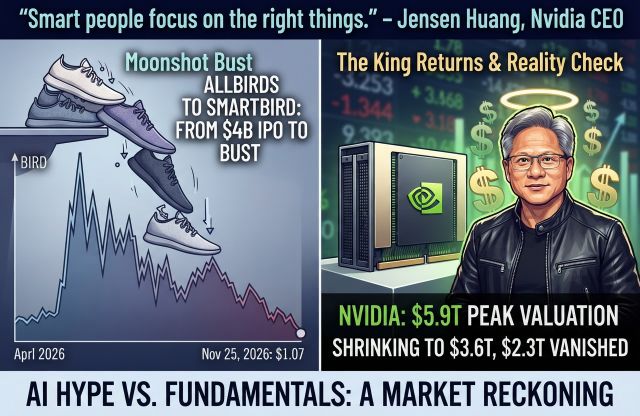
One shoe company, which specialized in cozy merino wool sneakers, was valued at a massive $4 billion right after its November 2021 initial public offering (IPO). Investors had high hopes for big profits. But by early 2026, it was burning through cash, closing storefronts, and watching its stock price stumble about in the basement around $2 a share.
These days, when you’re a business owner and no one wants to buy your sneakers, you do the next logical thing. You sell off the remaining parts of the shoe business and start renting out artificial intelligence (AI) chips. That’s the playbook used earlier this year by the company formerly known as Allbirds.
In March 2026, it sold off its entire footwear business, brand name, and remaining inventory to American Exchange Group for $39 million. Then, on April 15, 2026, it dropped a press release that made Wall Street go mad as a hatter.
The company announced it had lined up a $50 million financing deal to buy high-performance graphics processing units and lease AI computing power to businesses. It even asked shareholders to eliminate its environmental conservation charter – a fad from 2021 – because running data centers consumes far too much electricity for an ecofriendly mandate.
The business was initially rebranded as NewBird AI before settling on the name Smartbird in June 2026. It trades on the Nasdaq under the ticker BIRD.
The market reaction on the day of the press release was pure insanity. With roughly a fifth of the company’s shares sold short by traders betting on its demise, the sudden AI pivot triggered a violent short squeeze that was fueled by a stampede of retail traders.
In a single trading session, the stock moonshotted roughly 600 percent, spiking from under $2.50 to an intraday peak above $24.31. Over 280 million shares changed hands in a frenzy of speculative euphoria.
At the market close on Wednesday, November 25, 2026, Smartbird shares were sitting right around $1.07. That’s a wipeout of more than 95 percent from its April peak.
Speculative AI Hype
Smartbird’s pivot, no doubt, was an opportunistic market gimmick. Buying and leasing GPUs is one of the most capital-intensive games on the planet. A single high-end server configured with eight Nvidia chips costs upwards of $300,000. Moreover, global data center spending in 2026 has topped $450 billion.
Dedicated cloud infrastructure giants raise billions just to stay competitive. Showing up to a multi hundred-billion-dollar arms race with a $50 million financing line buys a few hundred chips at best. Without proprietary software, deep customer pipelines, or massive economies of scale, a former footwear maker rebranding as a cloud provider looks curiously like the late ‘90s era trick of slapping dot com onto a failing business just to catch a bid.
The collapse of microcap AI dreamers like Smartbird is an entertaining anecdote. Nonetheless, this exact speculative fever is what has been propping up the biggest stocks on earth. And during the week ending November 20, 2026, the hype was finally called into question.
Wall Street closed the week delivering the type of punishment investors have suffered only five other times since World War II. The S&P 500 fell every single trading day of the week, posting four separate drops of one percent or more. The last times the market pulled off that grim feat were during the depths of the October 2008 financial crisis and the week markets reopened after the September 11, 2001, attacks.
By Friday’s closing bell, the S&P 500 had shed roughly $6 trillion in market value over five days, down an official 10 percent from its October 6 record high. The Nasdaq plunged more than 5 percent on Friday alone, erasing its entire gain for 2026. What’s more, the Nasdaq ended just inches away from a full-blown 20 percent bear market.
Semiconductor stocks suffered the worst of the carnage. The PHLX Semiconductor Index plunged 17 percent on the week and lost a third of its value since the end of September.
What makes this selloff especially noteworthy is that it happened during what was supposed to be a celebration week for AI. Nvidia delivered its first earnings report since the scandalous departure of longtime CEO Jensen Huang, posting quarterly revenue of nearly $116 billion and more than doubling its top line from a year earlier.
Meanwhile, Anthropic pulled off the largest IPO in history. In a normal market, those twin milestones would have sent tech stocks to the moon. Instead, both stocks sank, dragging the entire semiconductor complex down with them.
The King Returns
Then came Monday, November 23, 2026, and Wall Street delivered one of the wildest plot twists in corporate history. Before the opening bell, Nvidia’s board pulled off a surprise reversal. It officially reinstating co-founder Jensen Huang as president, chief executive officer, and board director.
As you know, just eleven days earlier, Huang had stepped down after reports broke of his extramarital affairs, including a dalliance with a woman linked to Chinese intelligence. The scandal triggered national security alarms in Washington, sparked an SEC accounting probe, and left Nvidia without its leather jacket wearing leader.
Yet after intense behind-the-scenes lobbying, which included President Donald J. Trump personally phoning into a board meeting to push for Huang’s comeback and declaring he posed zero national security risk, the directors caved. To save face, Nvidia announced it would hire a new Chief Compliance Officer while ongoing government investigations play out. Huang will still have to answer questions before Congress in December.
Word of the king’s return sent Wall Street into a mania. On Monday, trading volume exploded to over 772 million shares as Nvidia stock rocketed 31.48 percent to close at $165.05. That single-day surge, Nvidia’s best since May 2003, instantly conjured roughly $950 billion in market value, shattering the all-time record for the largest one-day dollar gain by any company.
Huang’s resurrection didn’t just rescue Nvidia. It resurrected the entire stock market. Semiconductor rivals like AMD and Broadcom caught a massive tailwind. Major U.S. indexes staged a furious relief rally. Both the S&P 500 and the Nasdaq notched their biggest single-day percentage gains since April 2025.
By Tuesday, the adrenaline rush had worn off. Nvidia shares took a post-rally breather, dipping a modest 2.4 percent to close at $161.09. The slide continued on Wednesday, as shares dropped another 3.91 percent to finish the session at $149.30 ahead of the Thanksgiving break.
Regardless, the return of Huang, and the AI hype machine, doesn’t solve the underlying fundamentals of the AI business…
Levered Circular Financing
To understand why blockbuster earnings will not save the market, you must peek under the hood to see how this AI boom has actually been funded. Over the past couple of years, a massive web of leverage and circular financing has inflated demand across the tech sector.
Circular financing is an elaborate game of passing the same dollar around a table. For example, if you sell gumballs and you loan your neighbor $100, and he uses the $100 to buy gumballs from you, has real wealth been created?
Chipmakers and cloud giants have poured tens of billions of dollars in equity investments and credit lines into AI model developers and fledgling cloud startups. Those startups then turn right around and use that exact money to buy chips and rent data center capacity from the very companies that funded them.
Research from the Bank for International Settlements revealed that more than half of all investments flowing into AI companies came from other AI companies. Add in mountains of private credit, margin debt, and heavily leveraged hedge funds chasing momentum, and you get a fragile house of cards.
When asset prices start falling, leverage turns from a tailwind into a wrecking ball. Funds that borrowed heavily to load up on semiconductor stocks suddenly face margin calls, forcing them to dump shares at any price just to raise cash.
Nowhere is this reality check clearer than in Nvidia’s own market capitalization. Just seven weeks ago, on October 6, 2026, Nvidia was riding high at a record valuation of nearly $5.9 trillion. By market close on Wednesday (November 25), and even with this week’s massive rally, Nvidia’s market cap had been cut down to roughly $3.6 trillion. Hence, $2.3 trillion in shareholder wealth has been vaporized in less than two months.
We have little doubt that the AI technological revolution is real. The abilities and applications appear to be growing by leaps and bounds. But that doesn’t mean that at this specific juncture it’s a good investment. In fact, at this very moment there are likely much better investments out there.
This selloff is heavily concentrated in mega cap technology and semiconductor businesses. The equal weight S&P 500, which treats a mid-sized industrial or healthcare company the exact same as Nvidia, has held up remarkably well since the end of September. Real businesses outside the AI echo chamber are still trudging along.
There are also possible bargains – diamonds in the rough – to be found. Shares of Western Union, for example, are trading at a price-to-earnings ratio of 6.05 and are paying a dividend yield of 14.80 percent.
This is not a recommendation. We’re highlighting WU as an example, and to ask the question: Is it a bargain or is it a value trap with underlying fundamental problems?
And what about gold? Last we checked, it was going for $3,564 per ounce. Is this a screaming buy?
In the months ahead, those who can separate the wheat from the chaff, and not get distracted by AI hype, stand to scoop up real cash-flowing businesses – and real money – at fire-sale prices while everyone else is busy getting wrecked by tech.
Do your homework, stay selective, and protect your capital.
[Editor’s note: Get a free copy of an important special report called, “Beyond Crude – An Asymmetric Trade Hidden in a Disrupted Market,” when you join the Economic Prism mailing list today. If you want a special trial deal to check out MN Gordon’s Wealth Prism Letter, you can grab that here.]
Sincerely,
MN Gordon
for Economic Prism